

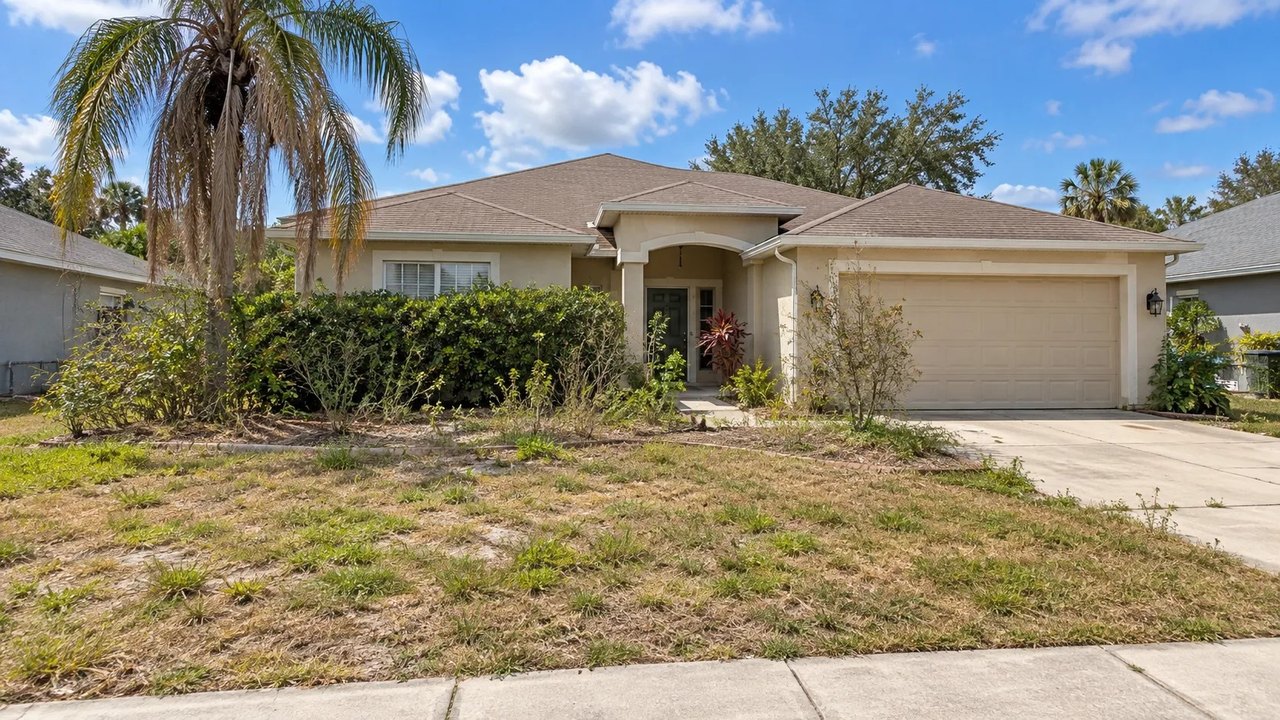
Most Florida front yards don't fail all at once. They drift. The lawn thins out on sandy soil, weeds fill the gaps, the foundation shrubs creep up past the windowsills, and the palm out front starts to look tired. Every weekend goes to keeping it from getting worse.
The yard in the photo above is a familiar version of that story. It isn't neglected so much as planted with things that ask for more than anyone wants to give: a lawn that needs regular feeding and watering to look good, shrubs that need shearing several times a year to stay in scale, and a palm whose thinning, browning crown suggests it needs more care than it's getting.
Low maintenance isn't something you get from a better mowing schedule. It's a decision you make at planting time, by choosing plants that already want to live here and giving them room to grow to their natural size.
So we took this one yard and designed three different low-maintenance looks for it: one that keeps a healthy lawn, and two that do away with the grass entirely. Each comes with a plant list and a supply list. Use them to do it yourself with plants from our nursery, or let us install the whole thing for you.
What low maintenance actually means in Florida
A yard that mostly takes care of itself in Tampa Bay usually has five things in common:
- Plants chosen for their mature size. A shrub that naturally stops at three feet never needs to be cut back from six.
- Plants that like sandy soil, summer downpours and dry springs. Florida natives and well-adapted ornamentals need little fertilizer and little water once established.
- Less lawn, or a healthier one. Turf is the most demanding thing in most yards. Shrinking it, replacing it, or giving it a fresh start all cut the work.
- Mulch or rock on every bare inch. Bare soil is an open invitation to weeds.
- Water delivered where it's needed. Drip or micro-irrigation to the beds, not spray heads watering the sidewalk.
Every look below follows those rules. They just arrive at very different places.
The three images below are design concept renderings of this same yard, created to show the direction of each look. They are not photographs of finished projects.
Look 1: Easy-Care Tropical, With a Healthy Lawn
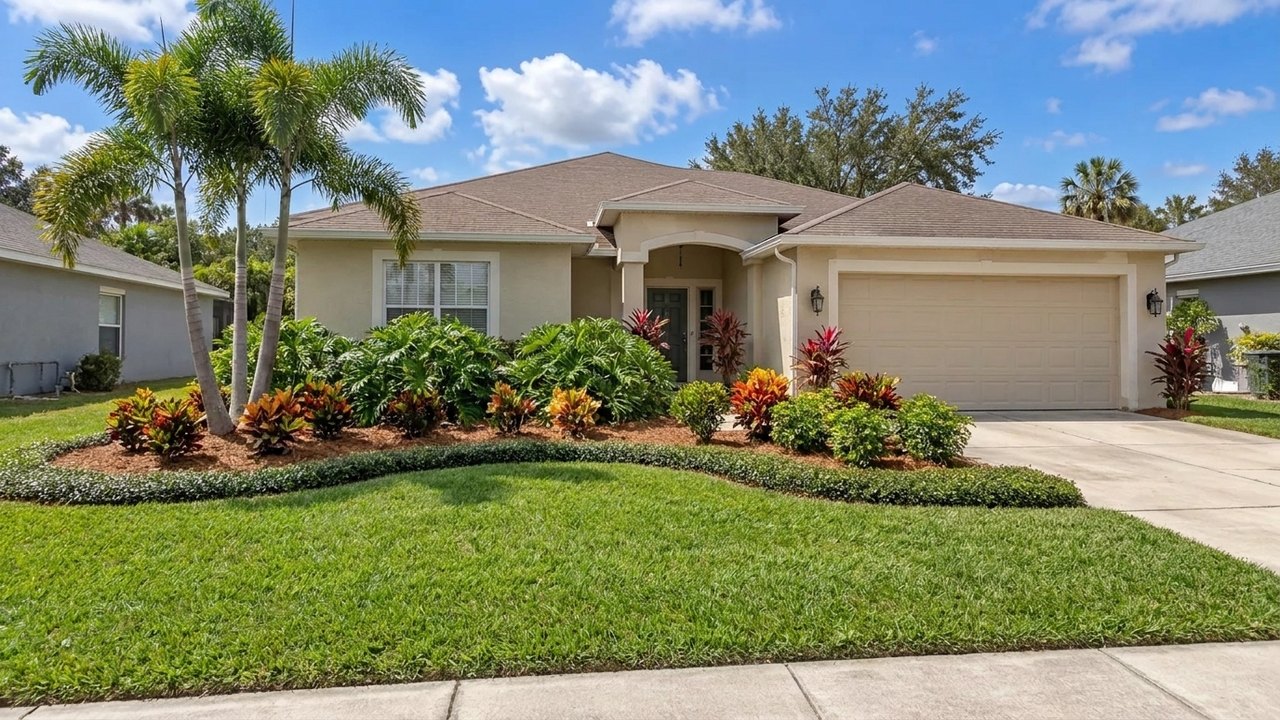
Not everyone wants to give up grass, and you don't have to. This look starts with a fresh, healthy lawn and builds deeper, lusher beds around it. A trio of Christmas palms replaces the old palm, and the beds fill in with crotons for year-round color, Xanadu philodendron for big glossy leaves, compact dwarf schefflera, and red ti plants that pick up the one already growing by the front door. A band of Asiatic jasmine edges the beds as a groundcover that crowds out weeds.
Why it's low maintenance: a lawn that starts healthy, on prepared soil, is far less work than one fighting weeds on thin sand. The deeper beds take a bite out of the mowing, and every shrub was chosen to stay below the windows without regular cutting. Christmas palms also drop their old fronds on their own.
Honest notes: this look keeps a lawn, so it's the most maintenance of the three. Crotons and Christmas palms dislike frost, so plan to cover the crotons on the few freeze nights we get, and plant crotons where pets won't chew them. If your current lawn is past saving, our sod team can help you choose the right grass for your sun and soil.
Plant list
- Christmas palms, a group of 3
- Crotons, in mixed colors
- Xanadu philodendron
- Dwarf schefflera
- Red ti plants
- Asiatic jasmine, as a groundcover along the bed fronts
- St. Augustine sod, or another grass suited to your sun and soil
Supply list
- Pine bark mulch
- Soil amendment for the beds and under the new sod
- Bed edging for a clean line between lawn and beds
- Irrigation adjustments so the beds and the lawn water on separate zones
What upkeep looks like after the first year: mow the lawn, trim the Asiatic jasmine back from the edges two or three times a year, and top up the mulch once a year.
Do you like this look? Tap the button below to start your free estimate.
Going Grass-Free: What to Know Before You Pull Up the Lawn
In most Florida yards, the lawn is the biggest demand on your time, water and budget. St. Augustine wants mowing every week through the summer, regular feeding and steady irrigation, and it still invites chinch bugs and weeds. Tampa Bay's watering restrictions limit how often you can run the sprinklers, and the summer fertilizer ban means most lawns go four months without being fed. A lawn can look great here. It just never stops asking.
A grass-free front yard swaps the turf for something that asks for less:
- A living groundcover. Perennial peanut, sunshine mimosa and Asiatic jasmine spread into a low green carpet. Perennial peanut and sunshine mimosa even flower, need little or no fertilizer, and only need an occasional mow if you want them tidy.
- Bigger planting beds. Shrubs and perennials, with mulch filling the space between them.
- Rock or gravel. The lowest-maintenance surface of all, and the easiest to keep crisp.
A few honest things to know first:
- Groundcovers take a season to fill in. Expect some weeding while they spread. Planting them closer together closes the gaps faster.
- Most groundcovers won't take heavy traffic. If kids or dogs run across the yard every day, keep a path or a small patch of turf where they play.
- Talk to your HOA before you start. Florida law says an HOA can't prohibit Florida-Friendly Landscaping, the state's term for water-conserving, drought-tolerant landscapes. Associations can still require you to submit plans and meet their design standards, so get approval first, especially for a rock or gravel yard.
The next two looks go fully grass-free, in two very different directions.
Look 2: The Florida Native Garden
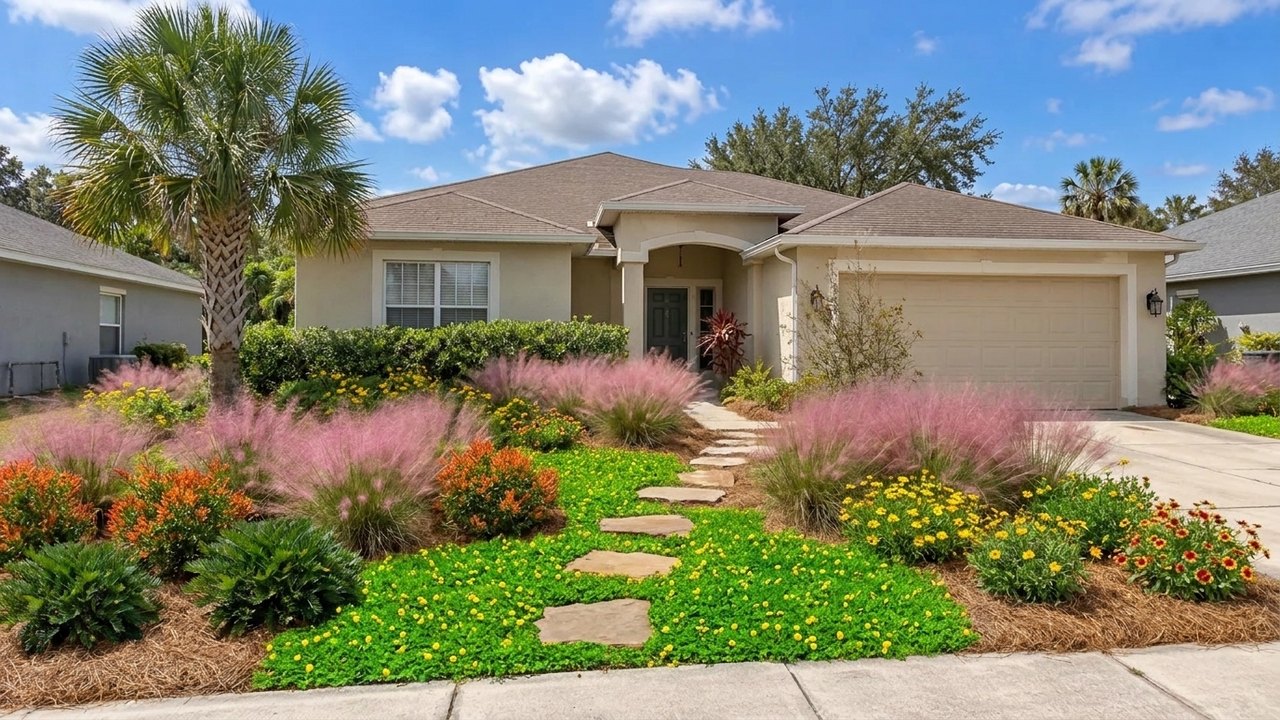
This look trades the lawn for a living groundcover and lets native plants do the work. A single sabal palm, Florida's state tree, replaces the struggling palm. Perennial peanut covers the ground where the grass used to be, with small yellow flowers much of the year. Drifts of muhly grass throw clouds of pink plumes every fall, right about now, and firebush and blanket flower bring in hummingbirds and butterflies. A soft Simpson's stopper hedge replaces the overgrown shrubs along the house and stays below the windows.
Why it's low maintenance: these plants evolved in sandy soil with wet summers and dry springs. Once established, most need little or no fertilizer and very little irrigation, and nothing here needs regular shearing.
Two honest notes: sabal palms are tough, but in parts of Tampa Bay they can be affected by lethal bronzing, a fatal palm disease spread by a small insect. If palms in your neighborhood have been lost to it, ask us about preventive trunk injection before you plant. And if you have a dog that chews plants, skip the coontie: like other cycads, it's toxic to pets.
Plant list
- Sabal palm (cabbage palm), 1, as the focal tree
- Muhly grass, in drifts of 5 to 7
- Firebush, 3 to 5
- Coontie, 5 to 7, as low evergreen mounds near the walk
- Beach sunflower, as a flowering groundcover at the bed edges
- Blanket flower, scattered for color
- Simpson's stopper, as a natural foundation hedge
- Perennial peanut, to replace the lawn
Supply list
- Pine straw mulch
- Compost or soil amendment for the planting holes
- Large flat stepping stones for a path to the front walk
- Drip or micro-irrigation for the first season while plants establish
- Landscape edging to keep the groundcover out of the driveway
What upkeep looks like after the first year: cut the muhly grass back once in late winter, trim the firebush once or twice a year if you want it tidy, and refresh the pine straw about twice a year. Perennial peanut can be mowed now and then for a neat look, or left alone.
Do you like this look? Tap the button below to start your free estimate.
Look 3: The Clean Modern Gravel Garden
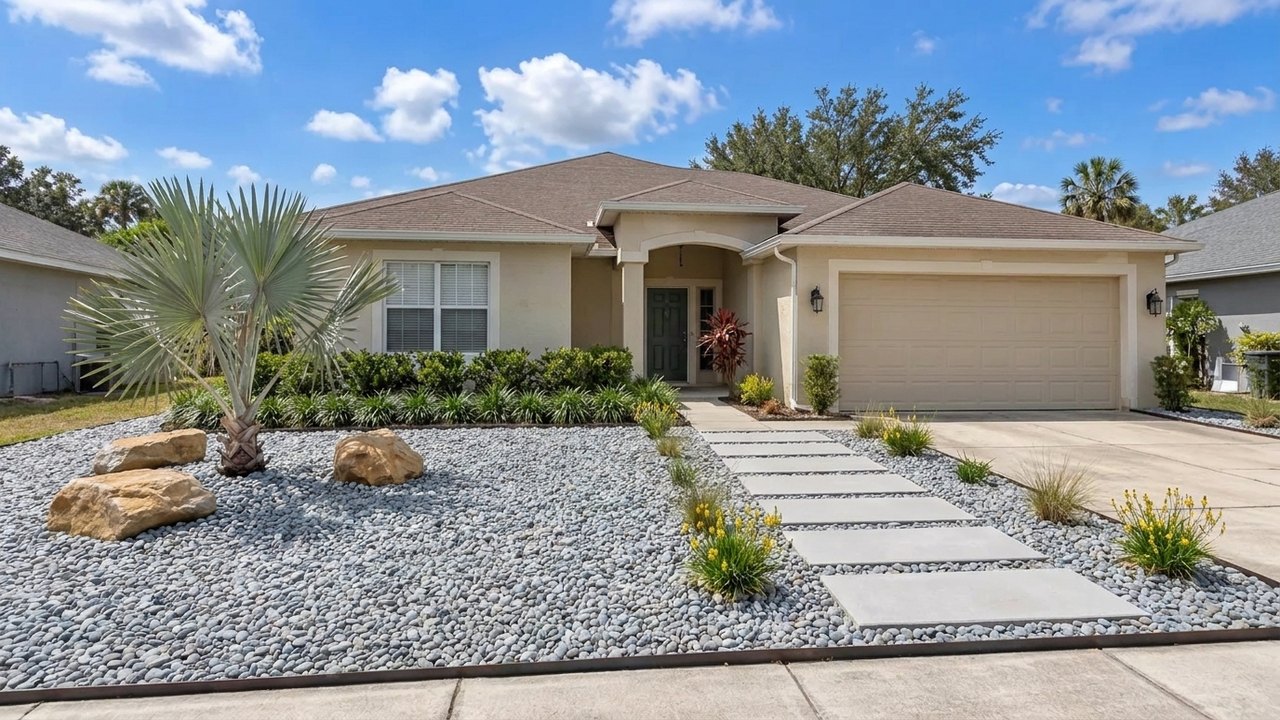
This is the look for anyone who never wants to start a mower again. The lawn is replaced entirely with river rock inside a crisp steel edge. A young Bismarck palm with silver-blue fronds becomes the focal point, grounded by a few natural boulders. Large concrete pavers step from the sidewalk to the door. Along the house, a low row of dwarf yaupon holly with a border of liriope keeps the lines clean, and a few clumps of dwarf Fakahatchee grass and bulbine soften the gravel.
Why it's low maintenance: there's no turf to mow, feed or water. The plants were chosen because they hold a neat shape on their own, so the hedge never needs to be sheared into a box.
Two honest notes: Bismarck palms get big. Over the years the crown can spread 15 feet or more, so plant it well away from the house and the walk. And gravel isn't quite zero work: it needs a fabric layer underneath to keep weeds down, and an occasional pass with a blower to clear leaves.
Plant list
- Bismarck palm, 1, as the focal tree
- Dwarf yaupon holly, in a row along the house
- Liriope, as a clean border in front of the holly
- Dwarf Fakahatchee grass, 3 to 5 clumps
- Bulbine, 3 to 5, for yellow flowers in the gravel
Supply list
- River rock or crushed stone to cover the former lawn
- Commercial-grade landscape fabric under the rock
- Steel or concrete edging
- Natural boulders, 2 to 4
- Large concrete stepping pavers
- Drip irrigation to each plant
What upkeep looks like after the first year: blow the leaves off the gravel now and then, pull the occasional weed that lands on top of the fabric, and remove the palm's old fronds when they brown.
Do you like this look? Tap the button below to start your free estimate.
Do it yourself, or let us do it for you
If you'd like to do it yourself, bring this page, or a photo of your own yard, to our nursery at 12032 Tarpon Springs Rd in Odessa. Our team will help you match the plant list to what's in stock that week, suggest the closest substitute if something isn't in, and talk through sun, soil and spacing for your property. Our plants are Florida-grown and already acclimated to Tampa Bay weather.
If you'd rather we do it, our team can take the whole look from start to finish: removing the old lawn and overgrown shrubs, preparing the soil, installing every plant, adjusting the irrigation, and finishing with mulch, rock or new sod. Schedule a free estimate and we'll walk your yard with you, or call us at (813) 920-8041.
Frequently asked questions
What is the lowest-maintenance landscaping for a Florida front yard?
The lowest-maintenance yards replace most or all of the lawn with mulched beds, rock or a living groundcover, and use plants that naturally stay the right size. Florida natives like coontie, muhly grass and firebush need very little water or fertilizer once established.
Can I replace my lawn with something that doesn't need mowing?
Yes. Perennial peanut and sunshine mimosa are popular Florida lawn alternatives that only need an occasional mow, Asiatic jasmine makes a dense evergreen groundcover, and a rock or gravel garden needs no mowing at all.
Can my HOA stop me from replacing my lawn?
Florida law says an HOA can't prohibit Florida-Friendly Landscaping, the state's term for water-conserving, drought-tolerant landscapes. Your association can still require you to submit plans and meet its design standards, so get approval before you start.
When is the best time to plant in Tampa Bay?
Fall is one of the best times. The heat has broken, and plants that go in now have the cooler months to root in before next summer. Plan to water new plants regularly for the first few weeks, since fall and spring are our drier seasons.
Do low-maintenance plants still need watering?
For the first several weeks to a few months while they establish, yes. After that, well-chosen Florida plants need far less, and many natives can get by on rainfall alone in most years.